
Why your A/C matters all year
Air conditioning isn’t only for hot days. In most vehicles, the defrost setting turns on the A/C automatically to keep the windows from fogging. That helps on a cold, wet morning in the Fraser Valley.
Summer matters too. BC’s Interior can get very hot.
How the system works
Your A/C moves refrigerant through a compressor, a condenser and an evaporator. Together they compress the refrigerant and cool the air the blower sends into the cabin. Hoses and connectors join the parts. In most vehicles, a belt from the engine drives the system.
If any one of those parts fails, the system stops cooling.
Signs your A/C needs attention
- The air from the vents is warm, or not as cold as it used to be.
- The airflow from the vents is weak.
- There’s a musty or strange smell when the A/C runs.
- You hear grinding or squealing when the A/C is on.
- The A/C keeps switching on and off.
Warm air can mean low refrigerant or a compressor problem. Weak airflow can come from a clogged filter or a failing blower motor. A musty smell can mean mould or bacteria in the system.
Why a top-up doesn’t last
If the refrigerant is low, it has escaped through a leak somewhere in the system. Adding more can improve cooling for a while, but the US Environmental Protection Agency says neither topping up nor recharging permanently fixes a leak. Repairing or replacing the part that leaks gives a longer-lasting result.
The rules in BC
BC’s Ozone Depleting Substances and Other Halocarbons Regulation covers vehicle air conditioners. Under it, a vehicle’s A/C must be leak tested before it is charged or recharged, and refrigerant must not be released into the air.
At Hub Motor Service
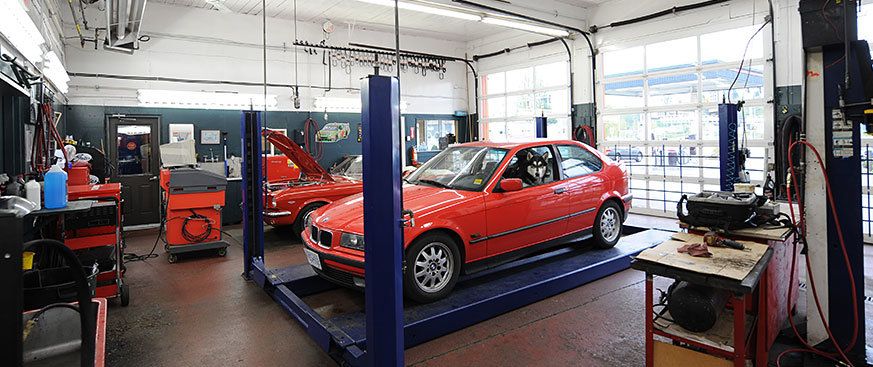
We do air conditioning service and repair in our five-bay shop at Essendene Avenue and Gladys Avenue, in downtown Abbotsford. Our team includes Myron Warkentin, Michael Warkentin and Corey Polson, all fully licensed Red Seal Automotive Technicians.
For the rest of your vehicle’s regular upkeep, see our oil changes and maintenance page.